Monday, 12 August 2013

Try me


(showing me how - notice she is wearing a winter coat.  It was raining that day and for them it is cold.  Admittedly it was chilly since I am also wearing my rain coat.) 

One of the many fantastic things about living this type of experience is that you get to try things you would not normally at home.  Another bonus is that since nobody knows you, you don't have the residue and weight of expectations or personality traits  you and others have imposed on you.  You can be whoever you want to be or let out who you really are or explore all options.  

During our field visits I have done three new things.  The first, basket weaving.  I LOVED this.  I felt like i could sit there all day and weave.  I was not in the thick of it since I was only working on the base of a basket but it seems to me to be a satisfying occupation since in the end you finish with a beautiful basket.  


(listening well) 


(on my own now)


(some of the farmers that were part of the focus group came to take photos of me doing this as well) 

The second, tilling some earth.  After a half hour or so walk out into the fields we came upon a large group of women who were just about to start turning over the earth to plant their seeds.  As soon as I set foot on the field I was handed a hoe and told to start to work.  I did not understand the words the women used but I sure did understand her intent.  My first thought was "Oh how Dad is going to love seeing this photo since I have never done any hard labour in my life".  Its true, I have had more than an easy life and the work these women do is so beyond difficult.  I can't imagine working like they do in the hot sun day after day.  It is pretty amazing.  


(there it is, proof that I have done some hard labour in my life.  Even if it was only for a few minutes hahahah)


(I have my back pack on because they gave me the hoe before i could even take it off)  


(the ladies behind me don't seem as impressed with my work hahaha)  

The third, dancing in the middle of a circle.  At the end of many of the focus groups we have the women sing a song and clap and some even dance. In this particular case the women were taking turns going in the middle and doing some dance moves of their own.  I usually stand in the background and clap along.  It is always a very emotional moment since it is then that I have those "Holy shit I'm in Africa" thoughts.  This time, I was invited into the circle to bust a few moves.  Luckily, Kate, a young women who works with us at one of the stations came in the middle with me and I was able to imitate her steps.  The women usually really LOVE the fact that the salimingas (white people) join in.  They also think we are pretty funny most of the time weather we dance or try to say a few words in their language.  They think we are funny but it is always appreciated and there is a feeling of thanks that we are making an effort.  


(clearly I am a bit embarrassed but having fun nonetheless and isn't Kate beautiful?) 

note: all of these photos were either taken by Elizabeth or Swanzy.  

Saturday, 10 August 2013


Nothing long today.  Just a few links to some interesting things about Africa.  Hope you enjoy them and keep browsing and digging and learning and thinking and understanding and questioning and loving and growing.  This is only the tip of the iceberg. 


TED radio hour on NPR called Africa : The Next Chapter 

http://www.npr.org/2012/06/29/155904209/africa-the-next-chapter

TED talk given by Nigerian author Chimamanda Ngozi Adichie

http://www.ted.com/talks/chimamanda_adichie_the_danger_of_a_single_story.html

TED on NPR search results for Africa 

http://www.npr.org/search/index.php?searchinput=Africa

TED talk search results for Africa 

http://www.ted.com/search?cat=ss_all&q=Africa

Book written by the Nobel prize winner Wangari Maathai

http://www.amazon.com/The-Challenge-Africa-Wangari-Maathai/dp/0307390284

Documentary from Northern Uganda

http://www.wardancethemovie.com/


Wednesday, 7 August 2013

Fields of Gold


In development work you often hear the words "going into the field".  In essence this means that you are stepping out of the office and away from your desk to be driven, usually in a pick up truck but sometimes on the back of a motorcycle (don't tell my parents :)), to a more remote part of the country.  It is the time to see and talk to local people near their homes.  These visits also often consist of focus group discussions where you gather a group and ask specific questions about the project you are working on.  These communities and groups are not random of course.  They are chosen according to the communities that were identified in the baseline studies of the project you are involved in.  A baseline study is a series of questionnaires asked to many many people in order to determine specific elements of your project.  This clarifies the behaviour and needs of the population you will be working with.  It also serves as a beginning point for the monitoring and evaluating officers who follow the progress of each project.  So basically, in the end, you will get a before and after in the communities that were targeted by the project. And more specifically for our project it is also a good opportunity for the radio teams to get some interviews with farmers on the up-coming topics of their radio shows.  That is a very brief and pretty vague explanation of these activities and terms.  I hope that for any readers who have been in development work for a long time this is not to far off the mark and for those who know nothing of this type of work that you get a small sense of it nonetheless.  


(the women and men are often separated during these discussions so that the women feel like they can truly express their opinions without feeling pressure from their husbands and other men in the community) 


(there are generally less men then women during the focus groups) 

Anyway, for me, field visits are an amazing time for many reasons.  It means seeing the landscapes that I have been dreaming of for so long.  It means meeting lovely people who almost never speak english but always manage to convey their joy and appreciation for your visits.  It means seeing every colour of the rainbow wrapped around, who I imagine, are some of the strongest women in the world.  Women who raise children, work on farms, have no running water, no toilet facilities.  Women who often never leave their village except to move to where their husband live.  Women who walk everywhere they go , who cook everything from scratch, who carry everything on their heads and backs.  


 (before this group walked by our focus group a women walked by with a wardrobe type dresser on her head.  I was not quick enough to snap a picture.  I have also seen a women walking down a main road in Tamale with her sewing machine on her head) 


(we literally were in the field this time.  The rest of the group was working away behind us while we conducted the focus group) 

It is strange because I thought I would have these moments of uncontrollable sadness and cry like a baby when I saw some of the intense poverty.  I haven't.  I think mostly because the people, their smiles and ease are more powerful than the dirty clothes and lack of "modern comforts".  When I ask the facilitators of the focus groups to mention that I will be taking pictures and to ask that they pretend I'm not there, there is often a moment of straightening dresses out and often veils being put on.  Just because we are miles away from "civilization" (please take note of the quotation marks) it does not mean that these women are not proud and don't want to look pretty.  And they are.  Gorgeous in fact.  


(Each women had a child either sitting on her or standing between their legs.  The children were not squirming, trying to get their mother or grandmother's attention.  They sat quietly and waited.) 


(You can see the shyness in their eyes and faces in this photo.  It often takes a few minutes for them to feel comfortable and really open up.) 


(Colours and veils and fabric and little people) 

I mentioned above the lack of and often complete absence of washroom facilities.  This is true not only in the villages but in town as well.  Their are restaurants, office spaces, homes that simply do not have washrooms.  I have seen more public urination here than I have ever cared to in my life.  Women are more discreet but men do it all over the place.   But my point here is not to talk about that.  What I wonder a lot about is women's sanitation.  What happens when they have their period?  If they never use toilet paper do they get infections?  How is it when they have sex with their husbands?  Is there any element of pleasure in it for them?  They probably do not drink enough water and the food here is sooooo oily, what does their urine look like?  Oily?  I know, not a very pleasant train of thought but as a women I wonder about these things.  In town (Tamale) there are shops who sell sanitary napkins but I wonder if everyone has the money to buy them and how much are they available in the remote villages? 


(a glimpse inside)


(houses)


(what's for diner?) 


(farming tools the women were using to turn the earth over to prepare for seeding) 


(house with satellites) 

You might think that women have been getting their period, etc. since the beginning of time and have figured it out BUT the twist here is that Ghana and probably a lot of other places are in a time of transition between the old world and the "modern" one.  Cell phone and satellite tv towers are going up everywhere before proper water access is.  Modified seeds and cash crops are creeping in endangering small scale farmers. Religious philosophy about marriage, sex and homosexuality are very prominent.     There is a strange disconnect that I can't seem to ever be able to find the right words to describe.  Even as I read this paragraph for the third time I wonder where these thoughts are going.  This is not so much a criticism but more of a puzzle that I can't quite seem to put together.  I have been here just about three months now and although I have observed many things I will not presume to truly understand the causes and effects of certain behaviour.  Although, for those who know me, I will keep trying to figure it out.  (maybe I should have studied sociology)  


(support the performing arts) 

Coming here has certainly made me question my behaviour.  As it would anyone I'm sure.  One thing that has made me uneasy is this (see photo above).  At first glance, and if you ignore my caption, you may just see a picture of a man.  BUT, he is wearing a shirt that was most definitely "donated" by a western person.  My first issue is that there is a stripper on his shirt.  There are no strippers in Northern Ghana.  This is in NO WAY part of their culture and behaviour.  In another village there was a young boy wearing a WWF (world wrestling federation) t-shirt.  Again, so far off anything in his reality, culture and tradition.  It bothers me a little bit that we donate, most probably feeling pretty good about ourselves, without thinking about who it is going to.  The other thing that bothers me about the donating of clothing phenomenon is that I have noticed that a lot of it ends up in shops and is being slod instead of given away.  It reminds me that it is really important to do research about any organization I want to donate to.  It also reminds me to check myself in general.  I'm sure the guy who originally wore this shirt thought it was hilarious and that it made him hilarious.  Me, I think it is sexist and it makes me sad that a small scale farmer in the very North of Ghana is wearing it.

On a happier note...

(these two little faces greeted us and we danced together to the music that was playing on the radio) 

Monday, 5 August 2013

Feet fall on the road Bound to motion Though chains be of gold They are chains all the same...


You have brains in your head. You have feet in your shoes. You can steer yourself in any direction you choose. You're on your own, and you know what you know. And you are the guy who'll decide where to go. - Dr. Seuss


Power and speed be hands and feet - Ralph Waldo Emerson


La langue qui fourche fait plus de mal que le pied qui trébuche. - Proverbe Africain


Keep your eyes on the stars and your feet on the ground. - Theodore Roosevelt


Heaven is under our feet as well as over our heads - Henry David Thoreau


I have but one lamp by which my feet are guided, and that is the lamp of experience. - Patrick Henry


I should like to lie at your feet and die in your arms. - Voltaire


And forget not that the earth delights to feel your bear feet and the winds long to play with your hair. - Khalil Gibran


Le vrai domicile de l'homme n'est pas une maison mais la route, et la vie elle même est un voyage à faire à pied. - Bruce Chatwin


Sunday, 21 July 2013

Chapter 5

The Little Prince 
by: Antoine de St-Exupéry
Chapter 5
(original version follows)
As each day passed I would learn, in our talk, something about the little prince's planet, his departure from it, his journey. The information would come very slowly, as it might chance to fall from his thoughts. It was in this way that I heard, on the third day, about the catastrophe of the baobabs.
This time, once more, I had the sheep to thank for it. For the little prince asked me abruptly--as if seized by a grave doubt--"It is true, isn't it, that sheep eat little bushes?"
"Yes, that is true."
"Ah! I am glad!"
I did not understand why it was so important that sheep should eat little bushes. But the little prince added:
"Then it follows that they also eat baobabs?"
I pointed out to the little prince that baobabs were not little bushes, but, on the contrary, trees as big as castles; and that even if he took a whole herd of elephants away with him, the herd would not eat up one single baobab.
The idea of the herd of elephants made the little prince laugh.
"We would have to put them one on top of the other," he said.


But he made a wise comment:
"Before they grow so big, the baobabs start out by being little."
"That is strictly correct," I said. "But why do you want the sheep to eat the little baobabs?"
He answered me at once, "Oh, come, come!", as if he were speaking of something that was self-evident. And I was obliged to make a great mental effort to solve this problem, without any assistance.
Indeed, as I learned, there were on the planet where the little prince lived--as on all planets--good plants and bad plants. In consequence, there were good seeds from good plants, and bad seeds from bad plants. But seeds are invisible. They sleep deep in the heart of the earth's darkness, until some one among them is seized with the desire to awaken. Then this little seed will stretch itself and begin--timidly at first--to push a charming little sprig inoffensively upward toward the sun. If it is only a sprout of radish or the sprig of a rose-bush, one would let it grow wherever it might wish. But when it is a bad plant, one must destroy it as soon as possible, the very first instant that one recognizes it.


Now there were some terrible seeds on the planet that was the home of the little prince; and these were the seeds of the baobab. The soil of that planet was infested with them. A baobab is something you will never, never be able to get rid of if you attend to it too late. It spreads over the entire planet. It bores clear through it with its roots. And if the planet is too small, and the baobabs are too many, they split it in pieces . . .
"It is a question of discipline," the little prince said to me later on. "When you've finished your own toilet in the morning, then it is time to attend to the toilet of your planet, just so, with the greatest care. You must see to it that you pull up regularly all the baobabs, at the very first moment when they can be distinguished from the rosebushes which they resemble so closely in their earliest youth. It is very tedious work," the little prince added, "but very easy."
And one day he said to me: "You ought to make a beautiful drawing, so that the children where you live can see exactly how all this is. That would be very useful to them if they were to travel some day. Sometimes," he added, "there is no harm in putting off a piece of work until another day. But when it is a matter of baobabs, that always means a catastrophe. I knew a planet that was inhabited by a lazy man. He neglected three little bushes . . ."
So, as the little prince described it to me, I have made a drawing of that planet. I do not much like to take the tone of a moralist. But the danger of the baobabs is so little understood, and such considerable risks would be run by anyone who might get lost on an asteroid, that for once I am breaking through my reserve. "Children," I say plainly, "watch out for the baobabs!"
My friends, like myself, have been skirting this danger for a long time, without ever knowing it; and so it is for them that I have worked so hard over this drawing. The lesson which I pass on by this means is worth all the trouble it has cost me.


Perhaps you will ask me, "Why are there no other drawing in this book as magnificent and impressive as this drawing of the baobabs?"
The reply is simple. I have tried. But with the others I have not been successful. When I made the drawing of the baobabs I was carried beyond myself by the inspiring force of urgent necessity.


Le petit prince
par: Antoine de St-Exupéry
Chapitre 5 

Chaque jour j'apprenais quelque chose sur la planète, sur le départ, sur le voyage. Ça venait tout doucement, au hasard des réflexions. C'est ainsi que, le troisième jour, je connus le drame des baobabs.
Cette fois-ci encore ce fut grâce au mouton, car brusquement le petit prince m'interrogea, comme pris d'un doute grave:
- C'est bien vrai, n'est-ce pas, que les moutons mangent les arbustes ?
- Oui. C'est vrai.
- Ah! Je suis content.
Je ne compris pas pourquoi il était si important que les moutons mangeassent les arbustes. Mais le petit prince ajouta:
- Par conséquent ils mangent aussi les baobabs ?
Je fis remarquer au petit prince que les baobabs ne sont pas des arbustes, mais des arbres grands comme des églises et que, si même il emportait avec lui tout un troupeau d'éléphants, ce troupeau ne viendrait pas à bout d'un seul baobab.
L'idée du troupeau d'éléphants fit rire le petit prince:
- Il faudrait les mettre les uns sur les autres...
Mais il remarqua avec sagesse:


- Les baobabs, avant de grandir, ça commence par être petit.
- C'est exact ! Mais pourquoi veux-tu que tes moutons mangent les petits baobabs ?
Il me répondit: "Ben! Voyons!" comme s'il s'agissait là d'une évidence. Et il me fallut un grand effort d'intelligence pour comprendre à moi seul ce problème.
Et en effet, sur la planète du petit prince, il y avait comme sur toutes les planètes, de bonnes herbes et de mauvaises herbes. Par conséquent de bonnes graines de bonnes herbes et de mauvaises graines de mauvaises herbes. Mais les graines sont invisibles. Elles dorment dans le secret de la terre jusqu'à ce qu'il prenne fantaisie à l'une d'elles de se réveiller. Alors elle s'étire, et pousse d'abord timidement vers le soleil une ravissante petite brindille inoffensive. S'il s'agît d'une brindille de radis ou de rosier, on peut la laisser pousser comme elle veut. Mais s'il s'agit d'une mauvaise plante, il faut arracher la plante aussitôt, dès qu'on a su la reconnaître. Or il y avait des graines terribles sur la planète du petit prince... c'étaient les graines de baobabs. Le sol de la planète en était infesté. Or un baobab, si l'on s'y prend trop tard, on ne peut jamais plus s'en débarrasser. Il encombre toute la planète. Il la perfore de ses racines. Et si la planète est trop petite, et si les baobabs sont trop nombreux, ils la font éclater.
"C'est une question de discipline, me disait plus tard le petit prince. Quand on a terminé sa toilette du matin, il faut faire soigneusement la toilette de la planète. Il faut s'astreindre régulièrement à arracher les baobabs dès qu'on les distingue d'avec les rosiers auxquels ils ressemblent beaucoup quand ils sont très jeunes. C'est un travail très ennuyeux, mais très facile."


Et un jour il me conseilla de m'appliquer à réussir un beau dessin, pour bien faire entrer ça dans la tête des enfants de chez moi. "S'ils voyagent un jour, me disait-il, ça pourra leur servir. Il est quelquefois sans inconvénient de remettre à plus tard son travail. Mais, s'il s'agit des baobabs, c'est toujours une catastrophe. J'ai connu une planète, habitée par un paresseux. Il avait négligé trois arbustes..."
Et, sur les indications du petit prince, j'ai dessiné cette planète-là. Je n'aime guère prendre le ton d'un moraliste. Mais le danger des baobabs est si peu connu, et les risques courus par celui qui s'égarerait dans un astéroïde sont si considérables, que, pour une fois, je fais exception à ma réserve. Je dis: "Enfants! Faites attention aux baobabs !" C'est pour avertir mes amis d'un danger qu'ils frôlaient depuis longtemps, comme moi-même, sans le connaître, que j'ai tant travaillé ce dessin-là. La leçon que je donnais en valait la peine. Vous vous demanderez peut-être: Pourquoi n'y a-t-il pas, dans ce livre, d'autres dessins aussi grandioses que le dessin des baobabs ? 


La réponse est bien simple: J'ai essayé mais je n'ai pas pu réussir. Quand j'ai dessiné les baobabs j'ai été animé par le sentiment de l'urgence.


Monday, 15 July 2013

Now I gathered up my sorrows And I sold them all for gold And I gathered up the gold And I threw it all away It all went for a good time and a song (come on) The laughter was like music It did float my soul along for awhile And all it really needed was the proper point of view


No photos today, just a blog about my thoughts.  

Apparently there are phases that one goes through when away volunteering like this.  We were told a lot about it during our pre-departure training.  They talked about the honeymoon phase, the “what the hell am I doing here” phase, and the feeling like home and settling in phase. Right now I’m in the I’m so lonely phase (not sure where that one fits in).  I know that this has been my dream for a long time.  In fact, I have been talking about it regularly for the past three years.  So much that I’m sure my friends were thinking, “I wish she would stop talking about it already and just go”.  I’m here.  Work is going well.  Everyone I work with is lovely.  I think I am accomplishing something and that I will make an impact.  I’m doing well with the fact that I don’t have all the clothes, tv channels and food choices I normally have. I’m even ok with the fact that we don’t always have water.  But, there are little things and big things that make it harder.  For example ANTS. Little insects, that are driving me big time crazy!!!  They are all over the kitchen.  If you leave one drop of anything out on the counter they completely take over.  I’m trying hard to put everything in ziplock bags or containers and to wash all of my dishes as soon as I’m done with them but my vigilance does not seem to be working. 

There is also the air conditioning unit in my room.  It does not always work.  You might think “Well at least you have an air conditioning unit” and I completely agree except when you have something and it only works half of the time, well, it is annoying.  

Also, on the more challenging and tiring side there are outings.  Every outing implies taking a taxi.  Every outing implies tons of “Saleminga hello” from any children who see you.  Every outing means at least one person saying that they would like to come to Canada.  Every outing means being stared at with people trying to get your attention.  The first hour is ok but add the heat and the amount of people out and about and it gets exhausting.  

Then there is nightfall.  It comes at 6h30pm here.  I can never be out alone after nightfall because it is not safe and I cannot trust all taxi drivers after dark because they are not all honest.  It means that so far I have only been out past 8pm about 10 times in two months.  

Finally, I’m disappointed in the fact that I have not really lived any kind or artistic performance. The only music I hear is slow jams from the 90’s, hip life (which is,  basically, Ghanian hip hop that sounds exactly like American hip hop) and country music.  I haven’t heard any variety in their sound.  I haven’t been to and have only heard of one artistic anything (concert, play, dancing, etc.)  There seems to be a sort of homogeneity about the culture here.  I only have two tv channels and what I see is that the TV produced here is in the “talk show” style.  A host sitting on a big couch discussing different topics with guests.  There are also tons of soap operas from Mexico, Brazil, India.  They are badly translated and are called things like Irrational Heart.  The Ghanian soap opera that I have seen shows people yelling and hitting each other a lot.  Not very interesting or encouraging. 

I’ve been reading or watching the episodes I brought on my computer.  I have gone to the pool a few times but again the amount of attention given by everyone is very tiring.  I wonder why all of these young men think it is appropriate to be so forward with a white woman.  They are definitely not like that with Ghanian women let me tell you.  

Rest assured, some of these things are not always annoying.  In fact, sometimes they are a source of strength because when you come home still smiling and have accomplished all your errands and things went smoothly you can be happy that you were able to do it.  There are always those short conversations with lovely people that make you feel better and the radiant smiles of my little neighbour kids that always help as well. One day at a time.   

Besides exterior factors there are also all of the internal struggles.  I’ve been carrying a lot of pain from broken hearts, abandoned friendships, anxiety and depression building up since childhood all still lodged in my heart filling it up. Not much room for the good stuff.  

I have placed my faith and love in the wrong places and with the wrong people. I have often blamed others for things that I did not truly work hard on myself. I have all of these super interesting projects that I do nothing about because I always say “when this happens then I will be able to do this, this or this”  I have put my life on hold because I think that it will somehow only truly start when I have a boyfriend.  I often thought I was so different from my family that they did not understand me and I’ve separated myself from them.  I’ve always thought that a man would make me complete.  I’ve always had so many expectations for others and myself and the moment they or I am disappointed everything is ruined.  A lot to carry around.  

Coming here, I was hoping to cleanse my heart, let go, become stronger, put my priorities in order.  Let me tell you, reader, it is hard.  When you are on your own, not only without friends and family but also one of the very few white people and there is often a language barrier, you have plenty of time to be in your head. Those who know me know that I spend too much time in my head as it is but now there are no distractions to get me out of it.  

Friends have been reminding me that this has been my dream for so long, telling me that I am strong and that i can get through this, that i will make more friends, that it will get easier, to enjoy every moment.  I agree with all of this and I know that it is all true.  I will make more friends.  I will get used to it.  I will enjoy it more and more.  This is my dream and I am living it.

BUT when I get home : family deserves more space in my life then I have given it.  My parents, my sister and brother in law, my grandmother, my cousins, my aunts, my roommate and her girls (because they are my family now) will get much more of my energy and time.  I have a much better idea of who I want to spend time with, which people make me happy and inspire me to be a better person and which people just hurt, which people make me feel like I’m not good enough. I’m not going to be anybody’s number two.  I’m going to come home fierce and make choices that don’t make my heart hurt.  I will make choices that feed me, that make me smile inside out.  I will make choices based on what I love not based on what I think others expect from me, this ideal that I have made up in my head about who Sylvie Harrison should be.  Cause the Sylvie Harrison that I am is pretty freakin’ wonderful and funny and charming and smart. I’m da shit. I am part of the Borg for goodness sake.  And you know I’m quite magical.  

Coming here was certainly a good step towards permanently believing all of that.  Coming here was the end of my waiting for something.  Coming here was getting into action.    

For those readers who know me and might be worried reading this, don’t be.  I’m fine.  Lonely but fine.  Tomorrow is another day.  I am safe.  Work is good.  I have everything I need.  This is just all part of being in Africa after getting a passport for the first time a few weeks before leaving.  Or at least it is for me.  Thank you for reading thank you for your support.  Thank you for your patience.  Thank you for your love.  

Monday, 8 July 2013

Won't you be my neighbour

Two for one this week.  Just thought I would share some seemingly not related photos of random things in my everyday life.  Lets start with Fadil!!!

(Fadil in my hat)

Fadil is one of the kids that are in my neighbourhood.  He caught my attention because as soon as he sees our cab drive up to the house he runs as fast as he can on his little bare feet (which incidentally is pretty fast) because he wants to shut the door of the cab once we are out.  He does not understand english but one day as he was hanging out and checking the tires and lights on our taxi a neighbouring woman walked by and noticed that I was chatting with him.  She asked him something and he nodded his little head.  Not a bob up and down just a one time yup with his head.  I asked the taxi driver to translate what she just said because his response made her laugh.  He told me that she asked him if he would marry me.  hehehe too freakin' cute.  I managed to make him smile with me for the first time this morning.  He'll be my great friend soon I just know it.  

(where I live)

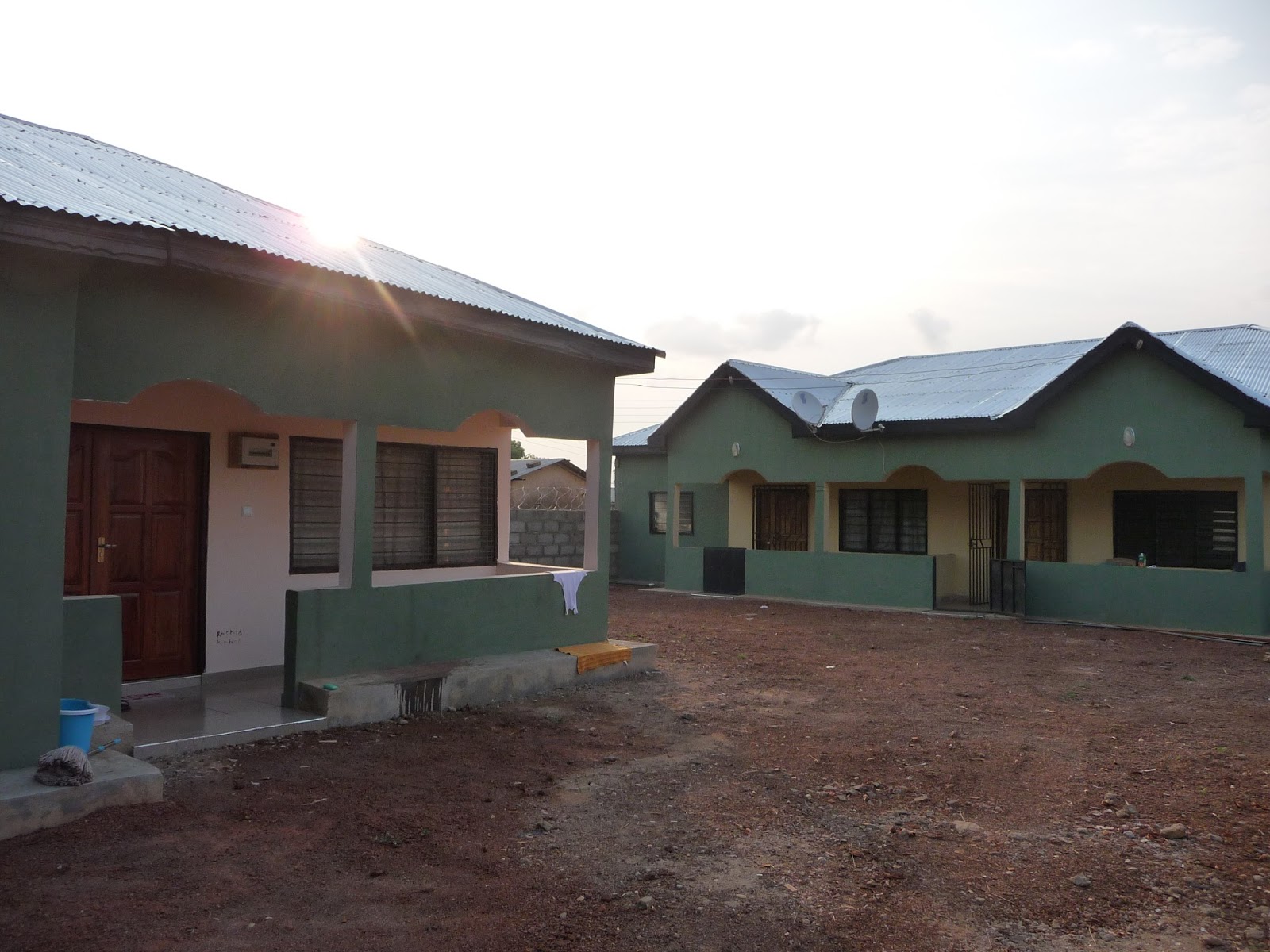
I have already posted a few photos of the inside of our place but my mom requested outside photos as well.  Notice there are three houses in our compound.  The one on the right is Elizabeth and I's two bedroom house.  On the left is a one bedroom house.  Shamima lives there.  She is a young woman who works for the Vodafone (Ghan's Bell) company. Her husband is away doing his studies in America and when he gets back he will live there with her.  In the third, three bedroom house, is Francis.  He is in in 30's and is an assistant lecturer at the university.  They are both extremely nice and I am thankful to have such great neighbours.  

(our little compound)

The neighbours on the outside of the wall are just as nice, at least the ones I have spoken to as brief as it may be sometimes.  The one I speak with the most is a seamstress that has a table set up just beside my house and just in front of hers.  I don't have any photos of her nor do I remember her name sadly. (I've noticed its difficult to remember names when they are so different from what I am used to hearing) I also am not enough aquainted with her to ask for a picture but I promise to have some at some point.  She works with three other ladies everyday at this table under the one tree that stands there.  Her english is good enough that we can chat and she can translate what the other ladies are saying.  She has a little tiny girl named Fahima (no pictures yet) that used to cry when she saw me.  White people are pretty scary to the little ones.  But, she is getting used to me as well and I'm just about getting some smiles out of her.  

(an artsy sewing photo)

(old school equipment) 

Just for fun I thought I would add some of our loot when we go to the market as well as a photo of the first meal we had at home that was not chicken and rice.  This happened some weeks ago but still worth sharing I think.  

(fish with roasted carrots and onions and a salad with lime and olive oil dressing)

(our market loot)

And speaking of small pleasures, I recently bought a tupperwear set.  I chose it because it had un unbelievably exciting feature.!!!!!!!!!!!!!!!!! 

(ooooooouuuHHHHHHH) 

(mmm apple!!!)

Lastly, I'll talk about an office protocol that seems to transcend in other organizations as well.  They call it Asset Registry and labelling.  In theory it is a very logical process that consists of making a list of the assets aquired for specific projects in order to keep track of expenses.  What is interesting, not to say odd (and well, I find funny) is that they label the office equipment.  You might say "that's not so odd" well take a look...

(my desk...labelled)

(a computer...labelled)

(chairs...labelled)

(air conditionner...labelled)

(printer...labelled)

On top of that, there is a specific person whom they refer to as an artist (and he very well may be) that comes in and does this for them.  The guy that did this batch took the entire day.  Elizabeth and I, when we were on our way to see our place for the first time, got a ride with a friend.  He mentioned he had something to do for the office before going to see the house.  On a saturday, we drove to the "artist's" house.  He came with us to the other end of town to meet, on the side of the road, a man who had a laptop.  The "artist" (again he may well be) took out his paintbrush and paint and labeled the laptop.  It was then handed back to the man standing on the side of the road.  He was warned that it would take some time to dry and to not put it back into the case.  We then drove back to the "artist's" house to drop him off and went on our way.  The only thing I can think of is that this is an ingenious way of creating jobs for artists.  Ghanian style!!!